Skip to content

Six strings. Tuned a little higher.

Your guitalele.
A little closer.

A little instrument with its own voice. Explore A–D–G–C–E–A tuning, discover chords and make your next note count.

  • Tuned a fourth above guitar
  • Small enough to go anywhere
  • Made for making music
Illustration of a natural-finish six-string guitalele, shown horizontally
Small guitar. Big possibilities.

Find your sound

Guitalele tuner

Select a string, then play it open. Standard tuning, from lowest to highest.

Target string

A2 · 110.00 Hz

Detected note

Start the microphone or play a reference tone.

Audio is processed on your device and is not uploaded. Reference tones use A4 = 440 Hz. Microphone access requires HTTPS or localhost.
Discover a new shape

Find your chord

Choose a root note and chord type to see its main shape for six-string guitalele in A–D–G–C–E–A tuning.

Type a chord code or use the selectors below. m7 = minor 7; M7 = major 7.
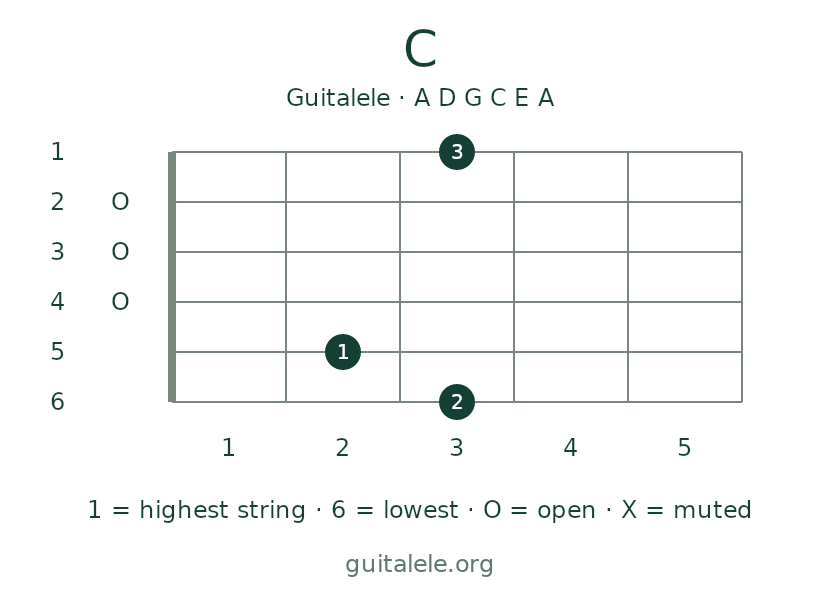
C guitalele chord; frets from string 6 to 1: 3, 2, 0, 0, 0, 3
Main suggested shape. Nut on the left; string 1 at the top and string 6 at the bottom.

A little higher. Note by note.

Find your note

Select a string and fret to discover its note.

Swipe or scroll to explore the frets. You can also use the selectors below.

C3
String 6 · Fret 3
130.81 Hz

Standard tuning: A2–D3–G3–C4–E4–A4 · A4 = 440 Hz

A little knowledge. A lot of music.

Get to know your guitalele

Guides for the curious player
01BEHIND THE INSTRUMENT

The story of the guitalele

Explore the background of this compact six-string instrument and its place in the world of music.

Read article
02STRINGS AND TUNING

How to string and tune

Choose suitable strings, fit them securely and tune all six strings to A–D–G–C–E–A.

Read article
03GET COMFORTABLE

How to hold your guitalele

Find a balanced position, relax your hands and play your first clear notes.

Read article
04THE FIRST NOTES

Your first chords

Read chord diagrams, learn Am and C and practise your first changes at a steady pace.

Read article